
Finance: A Real Lever for Dignity?
To what extent are financial inclusion and microfinance effective tools for reducing vulnerability?Finance: A Real Lever for Dignity?To what extent are financial inclusion and microfinance effective tools for reducing vulnerability?
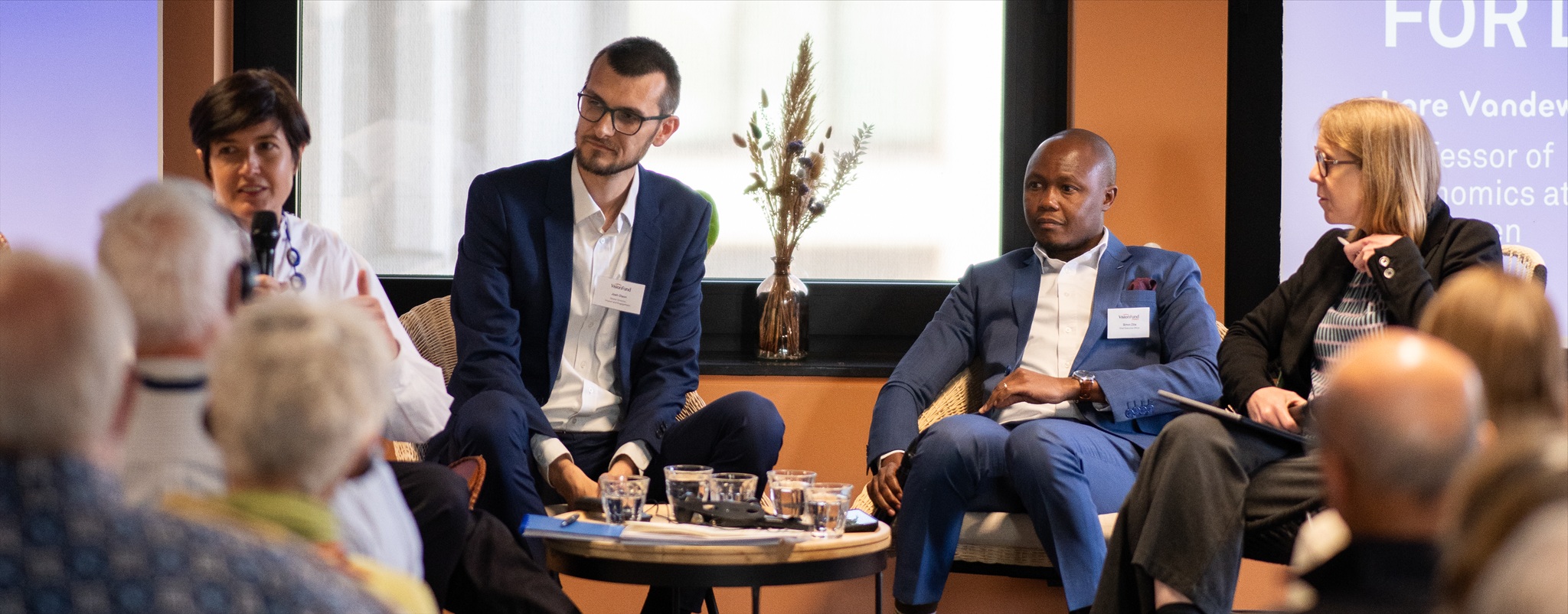
At Alterfin’s 2026 General Assembly, we brought together a panel to explore this question: Lore Vandewalle, Professor at KU Leuven; Simon Ziba and Josh Olson from VisionFund, an Alterfin partner; and Caterina Giordano, Chief Impact Officer at Alterfin.
For Lore Vandewalle, financial inclusion is not an end in itself. Nor is it limited to microcredit. It also relies on savings and micro‑insurance.
These tools help families manage irregular income, invest gradually, and cope with risks.
But a poorly designed financial service can also have harmful effects, as Josh Olson illustrated:
“Imagine a client in difficulty who must pull their child out of school to repay a loan. In that case, our loan no longer has a positive impact, but a negative one.”
To avoid such situations, VisionFund supports savings groups whose members pool resources to build an initial layer of financial security. Only once these groups are well established does VisionFund offer them loans.
As Director of VisionFund Zambia, Simon Ziba sees this approach working on the ground:
“These loans have a real impact on people’s lives and dignity. To prevent clients from being unable to repay their loan if they fall ill, we created a bundled product that includes health insurance.”
A Multidimensional Vulnerability
This approach is all the more relevant in the face of increasingly complex forms of vulnerability.
Poverty now affects health, education, housing, access to water and electricity, as well as the essential goods families need to live and work. Added to this are climate shocks, which hit already vulnerable populations hardest.
Lore Vandewalle reminded us that 1.1 billion people today live in acute multidimensional poverty, more than half of them children.
She also stressed that vulnerability takes harsher forms in contexts of poverty: for a low‑income worker in a developing country, missing just a few days of work can trigger an economic shock with lasting consequences. After several days without income, some parents have no choice but to withdraw their child from school.
.jpg)
Microfinance will not solve poverty on its own. But it can reduce vulnerability by enabling people to invest, weather difficult periods, build a safety net, or absorb shocks such as illness.
How can we maximize the impact of financial inclusion? Josh Olson explained:
“At VisionFund, we developed the Child Vulnerability Index, which provides geographic indicators of exposure to various risks: disease, climate events, and other drivers of poverty. We then tailor our insurance products to the most common risks in each area.”
Capital That Moves the Needle
The discussion unfolded against a troubling international backdrop. According to Lore Vandewalle, cuts in development aid could have massive human consequences: millions of additional deaths, many of them children.
Simon Ziba emphasized:
“In this difficult context, institutions like Alterfin are more essential than ever. Alterfin was VisionFund’s first external lender in Zambia, and its financing helped attract other partners.”
.jpg)
Josh Olson said he felt encouraged and inspired:
“Meeting partners who are driving change and learning from one another gives us courage. Finance, to me, is a lever for impact. That is what we strive for, using our capital, our time, our skills, and our networks to create lasting change in the communities we serve.”
In closing, Caterina Giordano stressed the importance of acting and building alliances rather than giving in to a sense of powerlessness:
“In this challenging context, we must better demonstrate the impact of our work, collaborate with organizations like VisionFund — which innovate, listen, and adapt to people’s needs — and grow alongside our cooperative members. Together, they show that capital can make a difference and improve people’s lives.”
.jpg)
TestimonialS

FAQ title
FAQ description
Invest in human yield
Become a co-op member
more news from alterfin


DIDN't find what you're looking for?
Read our FAQs or contact us.


